


LED vs T5 vs Mercury Vapor: Which Reptile & Aquarium Light Actually Works Best in 2026?
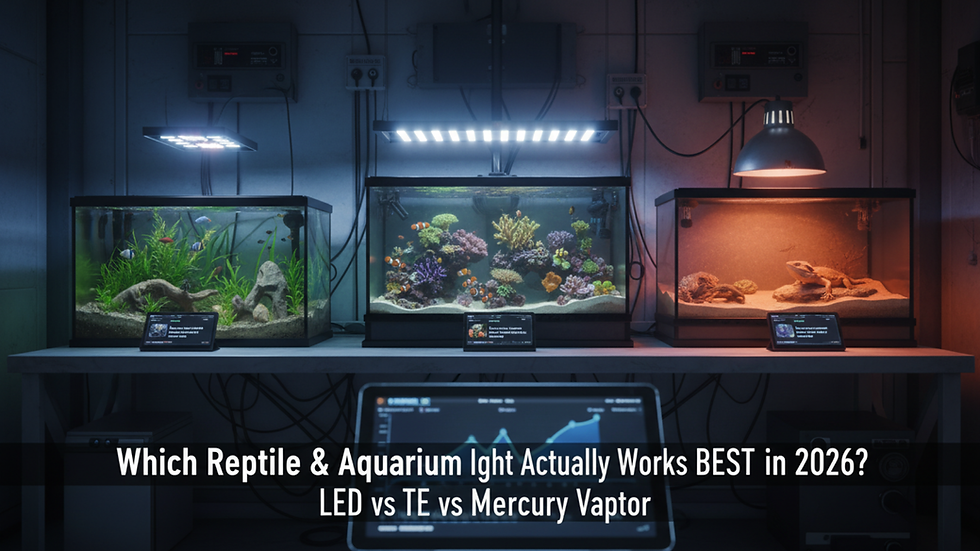
LED, T5 fluorescent, and mercury vapor are the three big lighting technologies most keepers compare when setting up reptile enclosures or aquariums, and each shines in different situations. This article gives you a clear, SEO‑optimized comparison so readers can quickly see what “actually works best” for their animals and their budget in 2026.
What This Guide Covers
Core differences between LED, T5, and mercury vapor (and where T8 fits)
UVB, PAR, and heat output for reptiles and aquariums
Energy use, lifespan, and long‑term cost
Safety, mounting, and enclosure size considerations
Simple “best choice” recommendations by animal and tank type
Quick Overview: LED vs T5 vs Mercury Vapor
LED: Cool‑running, ultra‑efficient, long‑life, highly controllable spectrum; UVB versions exist for reptiles and high‑PAR versions for plants and corals.
T5 High Output fluorescent: Strong, even UVB / visible output, proven for reptiles and planted/reef tanks, but shorter life and higher power draw than LED.
Mercury vapor / metal halide: Intense all‑in‑one bulbs that produce heat, UVA, UVB, and bright visible light from one lamp; great for big, open enclosures but power‑hungry and easy to overdo.
UVB & Spectrum: Which Tech Keeps Reptiles Healthiest?
LED UVB
New LED UVB diodes can deliver usable UVB for reptiles without mercury and with very long lifespans.
Pros: Long life (up to ~20,000 hours claimed), energy‑efficient, no mercury, very compact.
Cons: Spectra differ from sunlight and long‑term effects are still being studied, so most herp vets still prefer proven T5 tubes for critical UVB needs.
T5 High Output UVB Tubes
T5 HO tubes are now the “standard answer” when you ask experienced keepers and brands which UVB is best.
Deliver strong, even UVB across a wide area, ideal for bearded dragons, uromastyx, tortoises, iguanas, and large chameleons.
More efficient and powerful than older T8 tubes, with better lumen‑ and UVB‑per‑watt ratios.
Mercury Vapor / Metal Halide UVB
Self‑ballasted mercury vapor bulbs and UV metal‑halide lamps output heat, UVA, UVB, and bright visible light from a single point source.
Excellent for big, open‑topped desert enclosures where animals can choose their own distance.
UVB and heat can be too intense in small vivariums, and output can drop faster than with modern T5 units.
Takeaway for reptiles:
For most modern setups, a quality T5 HO UVB kit still offers the best mix of safety, coverage, and proven biology.
Mercury vapor is a niche choice for large, open habitats and experienced keepers.
LED UVB is promising, but should be from reputable brands and used with a UV meter until long‑term data is clearer.
PAR, Spectrum & Color: Which Tech Wins for Aquariums?
LED has decisively replaced most older technologies for both freshwater and marine tanks.
Up to 80–90% more efficient than fluorescent and metal‑halide fixtures.
High PAR output with customizable spectrum for planted tanks and reefs.
Allow programmable sunrise/sunset, moonlight, and storm modes that boost aesthetics and reduce fish stress.
T5 / T8 Aquarium Fluorescents
T5 and T8 tubes still work and many planted and reef systems used them successfully for years.
Provide broad, even light but gradually dim and shift spectrum, so they must be replaced every 6–12 months.
Shorter lifespan and higher power draw than LEDs make them less attractive long‑term.
Metal Halide for Reefs
Metal halide fixtures were once the gold standard for high‑end reef aquariums because of their very high intensity and shimmer.
Extremely hot and power‑hungry (150–400 W per fixture is common).
Largely replaced by powerful reef LEDs that mimic halide PAR without the heat and running costs.youtube
Takeaway for aquariums:
LED is the clear winner for nearly all planted and reef tanks in 2026, thanks to efficiency, control, and longevity.
T5 still has a role in budget builds or hybrid LED/T5 reef systems, but it is no longer the “default best.”
Energy Use, Lifespan & Cost of Ownership
Technology | Typical Lifespan | Efficiency & Heat | Notes |
LED (reptile & aq) | 20,000–50,000 h | Up to 80–90% more efficient than older bulbs; runs cool. | Highest upfront cost, lowest long‑term cost. |
T5 HO Fluorescent | ~8,000–12,000 h | Moderate efficiency; some heat from tube & ballast. | Needs annual replacement for UVB/plant performance. |
T8 Fluorescent | ~6,000–10,000 h | Less efficient and weaker than T5. | Being phased out in many applications. |
Mercury Vapor / MH | ~3,000–6,000 h | Very high power draw and heat output. | Great intensity, but costly to run and cool. |
Long‑term, LEDs significantly reduce both electricity and bulb‑replacement costs in multi‑tank rooms and reptile rooms.
Safety & Installation: What’s Safest for You and Your Animals?
LED:
Very low surface temperature and no mercury; often CE and RoHS certified.
Ideal over aquariums where accidental splashes are likely, as many fixtures are IP‑rated against moisture.
T5/T8:
Safe when used in proper fixtures with reflectors and splash guards.
Need adequate ventilation; ballasts can get warm.
Mercury vapor / metal halide:
Strong point‑source heat means you must strictly follow minimum distance guidelines to avoid burns or overheating.
Glass envelopes contain mercury; broken bulbs require careful cleanup and disposal.
For reptile UVB, professional guides increasingly recommend separate heat and UVB sources (e.g., halogen basking plus T5 UVB) for fine‑tuning.
references
https://blog.warehouse-aquatics.co.uk/fish-tank-lights-t8-t5-or-led/
https://zoomed.com/lighting-uvb-education-reptile-lighting-terms/
https://www.reptiles.swelluk.com/help-guides/how-to-select-the-right-lighting-for-your-reptile/
https://reptilesmagazine.com/uvb-lighting-for-your-reptiles/
https://www.2hraquarist.com/blogs/light-3pillars/planted-tank-lighting-101
https://aquaforest.eu/en/knowledge-base/aquarium-lighting-guide-your-most-common-questions-answered/
https://www.reddit.com/r/PlantedTank/comments/wsvggb/fluorescent_vs_led_lighting/
https://talis-us.com/blogs/news/best-reptile-lighting-types-and-choices
https://www.facebook.com/groups/1782696728589140/posts/2849173351941467/
https://www.marketreportanalytics.com/reports/reptile-pet-lamp-49552
https://www.2hraquarist.com/blogs/light-3pillars/light-t5vsled
https://www.alibaba.com/product-detail/2025-Factory-Price-Reptile-Lamp-23W_1601392241016.html
https://www.chameleonforums.com/threads/mercury-vapor-lighting.73146/


