


Bearded Dragon Lighting Guide: UVB Placement and Duration
Updated: Mar 23

Practical tips for proper lamp choice and enclosure setup for bearded dragons
Introduction
Bearded dragons are one of the most popular pet reptiles worldwide, adored for their friendly demeanor, unique personalities, and striking appearance. However, to keep them healthy and thriving in captivity, setting up the correct lighting—especially UVB lighting—is absolutely essential. This guide will cover everything keepers need to know about lamp types, placement, enclosure lighting design, and optimal durations, providing actionable, SEO-optimized advice for both new and experienced owners.
Why Proper UVB Lighting Matters for Bearded Dragons
Bearded dragons originate from the sun-soaked deserts and woodlands of Australia. Their bodies are adapted to basking under intense sunlight, which not only provides visible light and heat but also emits ultraviolet B (UVB) rays. UVB serves a critical biological function: it enables bearded dragons to synthesize Vitamin D3 in their skin, which is essential for calcium absorption and skeletal health.
Without adequate UVB exposure, bearded dragons are at risk of developing metabolic bone disease (MBD), a painful, often fatal condition characterized by brittle bones, deformities, and neurological issues. Even with a calcium-rich diet, a lack of UVB can render bearded dragons unable to process this vital nutrient, leading to severe health consequences.
Understanding Light Types: The Bearded Dragon’s Requirements
Bearded dragons require three main types of lighting in captivity:
UVB Light: For Vitamin D3 synthesis and calcium metabolism.
UVA/Daylight: To support vision, feeding, activity, and normal behavioral rhythms.
Heat/Basking Light: To regulate body temperature and support digestion.
Full-spectrum lighting is ideal, but “full-spectrum” bulbs do not automatically provide UVB. Always use a dedicated, high-quality UVB source.

Choosing the Right UVB Lamp
Best UVB Bulb Types
Linear Fluorescent Tubes (T5HO Recommended):
Arcadia 12–14% T5 HO
Zoo Med Reptisun 10.0 T5 HO
High-output tubes with strong, even UVB distribution.
Mercury Vapor Bulbs: Provide both heat and UVB, but may be too powerful for smaller tanks or beginners.
Avoid coil/compact fluorescents as a sole UVB source—they offer uneven coverage and have been linked to eye issues.
Bulb type | Good for | Main advantage | Main risk |
T5 HO linear tube | Most bearded dragon setups | Strong, even UVB coverage | Needs correct distance |
Mercury vapor bulb | Advanced setups | Heat + UVB in one bulb | Can be too intense |
Coil/compact bulb | Limited use | Small format | Uneven coverage as a sole source |
How to Size Your Bulb
For standard 120x60x60 cm (4'x2'x2') tanks, choose bulbs at least half the enclosure’s length for even basking areas.
Use brands such as Arcadia and Zoo Med for consistent UVB output and reliable manufacturing.

UVB Lamp Placement: Over or Under Mesh?
The position of the UVB bulb is crucial for effective exposure:
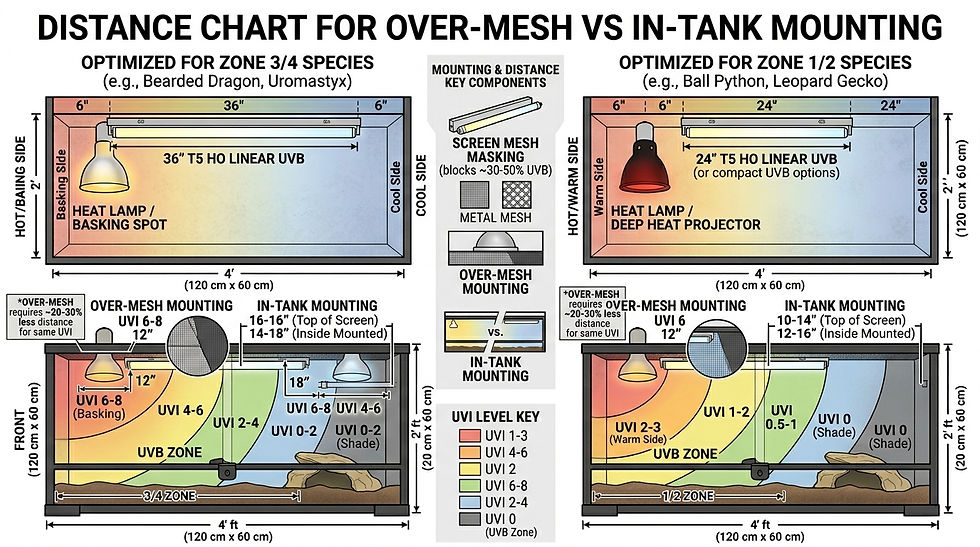
Over the Mesh/Screen Top:
Most standard tanks are 18–24 inches high, with a mesh lid.
Mesh can block 30–45% of UVB output, substantially reducing your dragon’s exposure.
Recommended basking spot distance:
7–11 inches (18–28 cm) below the bulb with mesh
Use a T5 HO UVB for penetration
Under the Mesh (Inside Tank):
In taller or custom enclosures (>24 inches tall), mount the bulb inside.
Safe distance: 12–18 inches (30–46 cm) below bulb for T5 HO bulbs
Always use a reflector to maximize bulb efficiency.
Pro Tip: Use a Solarmeter 6.5 to measure the UV Index (UVI). The basking area should have a UVI of 4.0–6.0—the Ferguson Zone 3 ideal for bearded dragons.
Lighting Layout: Where Should You Place the Bulbs?
Basking Zone: Place UVB and basking bulbs next to each other, not overlapping, so heat and UVB coincide at the basking site but there’s a gradient across the tank.
Coverage: The UVB tube should span at least two-thirds of the enclosure’s length, running parallel with the basking bulb.
Shaded Retreats: Ensure one end of the tank remains dimmer, so your dragon can self-regulate, just like in nature.
Schedule: How Long Should Lights Be On?
Day Length: Mimic the natural Australian outback photoperiod:
Summer: 14 hours ON, 10 hours OFF
Winter: 10–12 hours ON, balance OFF
Use a timer to keep day/night cycles regular, which helps regulate feeding, activity, and sleep.
Tip: Let natural room light increase before turning on tank lights in the morning, and keep them on for 8–12 hours, ensuring a gradual sunset
Should You Use Night Lights for Bearded Dragons?
NO “Night” (red, black, or blue) bulbs are necessary for bearded dragons!
Bearded dragons can perceive colored light, and unnatural light at night can cause stress, disrupt sleep, and interfere with hormone cycles.
For nighttime heat, use non-light-emitting ceramic heat emitters if temperatures drop below 55ºF (13ºC).
Signs of Inadequate UVB & Common Lighting Mistakes
Signs of Problems
Faded coloring, lethargy, loss of appetite
Weakness, twitching muscles, soft jaw or tail bones
Poor growth in young dragons
Trouble shedding
Common Lighting Errors
Using the wrong bulb type (e.g., coil/compact vs. linear tube)
Bulb too far from basking spot
Mesh lid blocking too much UVB, or placing lamp above glass/plastic
Not using a reflector
Failing to replace bulbs regularly (T5: every 12 months, T8: every 6 months)
Advanced: Measuring and Fine-Tuning
A UVI meter (Solarmeter 6.5) lets you precisely measure basking area UV exposure.
Adjust bulb height and wattage until basking spot reads 4.0–6.0 UVI for optimal synthesis.
Gradually taper the photoperiod over months to reflect natural changes.
Additional Tips for Perfect Lighting
Pair UVB and basking bulbs on the same side for a thermal/UV gradient.
Avoid glass or plastic covers above bulbs, as these block UV.
Use LED full-spectrum bars in conjunction with UVB tubes for color vibrance and plant growth, but not as a stand-alone UVB source.
Provide natural rocks, branches, and logs under the basking lamp to let your dragon choose its own distance from the light.
Conclusion
The best bearded dragon UVB setup combines the right bulb, the right distance, and a safe basking gradient. For most enclosures, a T5 HO linear tube with a measured basking target is the most reliable choice. Before buying a new lamp, check your enclosure height, mesh top, and basking platform distance.
Quick setup for most bearded dragons
Use a T5 HO linear UVB tube
Target UVI 4.0–6.0 at the basking zone
Mount over mesh only if distance is adjusted for UV loss
In taller tanks, mount inside the enclosure with a reflector
Run lights about 10–14 hours daily depending on season
Replace bulbs on schedule and recheck distance regularly
Ready to upgrade your bearded dragon’s home? Explore CTT’s advanced, energy-efficient reptile UVB lighting solutions—engineered for true desert brilliance!
FAQs
Can UVB go through glass?No. Glass and plastic can block UVB, so the bulb must shine directly into the enclosure.
How far should a T5 HO UVB bulb be from a bearded dragon?It depends on the bulb strength, reflector, and whether mesh is blocking output, but your basking zone should land around the correct UVI target.
Should UVB and basking heat be on the same side?Yes. That lets the dragon warm up and absorb UVB in the same basking area while keeping a gradient across the enclosure.
How many hours a day should UVB stay on?Usually about 10–14 hours depending on season and husbandry style.
Do bearded dragons need night lights?No. Colored night bulbs can disrupt rest. Only use non-light heat at night if temperatures are too low.
When should I replace a UVB bulb?Follow the bulb schedule and confirm performance with a meter if possible.


