Not All UVB Reptile light Is Created Equal — A Buyer’s Guide to UVB 2.0, 5.0, and 10.0
Updated: Jun 29

Quick Answer
Choosing the right UVB reptile light depends on your reptile's species, enclosure size, basking distance, and target UV Index (UVI). While compact UVB bulbs work well for smaller enclosures, T5 High Output fluorescent tubes generally provide stronger, more even UV coverage for medium and large habitats. Comparing UVB lights by their actual performance—not just their UVB percentage—helps create a healthier environment for long-term reptile care.
Choosing the right UVB reptile light is essential for maintaining reptile health and preventing calcium deficiency. However, with so many UVB bulb types available, selecting the best option can be confusing. In this UVB reptile light comparison guide, you’ll learn the differences between popular UVB lighting systems and how to choose the right setup for your reptile species.
Why UVB Lighting Matters for Reptiles
UVB lighting allows reptiles to produce vitamin D3 naturally, which helps them absorb calcium and maintain strong bones. Without proper UVB exposure, reptiles can develop serious health issues such as metabolic bone disease.
Different reptiles require different UVB levels depending on their natural habitat and basking behavior.
UVB Lamp Comparison
Lamp Type | Best For | Advantages | Considerations |
T5 High Output | Medium to large enclosures | High UV output, wide coverage, long lifespan | Requires compatible fixture |
T8 Fluorescent | Small to medium enclosures | Affordable, reliable | Lower UV intensity than T5 |
Compact UVB Bulb | Nano habitats and temporary setups | Easy installation | Smaller coverage area |
Mercury Vapor Bulb | Large desert enclosures | Provides heat and UVB together | Generates more heat and requires greater mounting distance |
Each option has strengths depending on enclosure design and reptile species.
UVB 5.0 vs UVB 10.0
One of the most common questions among reptile keepers is whether to choose a UVB 5.0 or UVB 10.0 lamp.
UVB 5.0 | UVB 10.0 |
Lower UV output | Higher UV output |
Suitable for many tropical species | Better suited for many desert species |
Often used in shorter enclosures | Often used in taller enclosures |
Appropriate for lower target UVI | Appropriate for higher target UVI |
The correct choice depends on the UV Index at the basking spot, not simply the number printed on the bulb.
Understanding UV Index (UVI)
Modern reptile husbandry focuses on the UV Index (UVI) rather than UVB percentages.
The UV Index measures the biologically effective ultraviolet radiation that actually reaches the reptile.
General recommendations include:
Species | Ferguson Zone | Target UVI |
Crested Gecko | Zone 1 | 0.5–1.0 |
Leopard Gecko | Zone 1–2 | 0.5–1.5 |
Corn Snake | Zone 2 | 1–2 |
Bearded Dragon | Zone 3 | 3–6 |
Uromastyx | Zone 4 | 4–7 |
Matching UV exposure to the reptile's natural habitat provides healthier long-term results.
Coverage Matters More Than Brightness
A powerful bulb does not always create better lighting.
Long fluorescent tubes generally provide:
More even UV distribution
Better basking gradients
Reduced shadowing
More natural movement throughout the enclosure
Compact bulbs often create concentrated hotspots that provide less usable coverage.
Creating a natural UV gradient allows reptiles to regulate their own exposure.
What Should You Compare When Choosing a UVB Light?
Many reptile keepers focus only on the UVB percentage printed on the package, such as 5.0 or 10.0. However, several factors influence how much usable UVB actually reaches your reptile.
When comparing UVB lights, consider:
UV Index (UVI) at the basking area
Lamp type
Reflector quality
Effective coverage
Recommended mounting distance
Lamp lifespan
Energy efficiency
Species-specific requirements
Looking at the complete lighting system provides a more accurate comparison than UVB percentage alone.
UVB Lamp Lifespan Comparison
Even when bulbs continue producing visible light, UV output gradually decreases.
Lamp Type | Typical Replacement Interval |
Compact UVB | 6–8 months |
T8 Fluorescent | 6 months |
T5 High Output | 12 months |
Mercury Vapor | 10–12 months |
Regular replacement helps maintain consistent UV exposure.
Best UVB Lights for Different Reptiles
Different reptile species require different UVB intensities:
- Bearded dragons → High UVB (T5 or mercury vapor)
- Leopard geckos → Low UVB (compact or low-output T5)
- Iguanas → Moderate to high UVB
- Turtles → Moderate UVB with basking support
Matching the UVB light to the species is essential for proper health.
Common Buying Mistakes
Avoid these common purchasing mistakes:
Buying based only on UVB percentage
Ignoring enclosure height
Choosing the wrong reflector
Using compact bulbs in large enclosures
Forgetting to account for mesh screen reduction
Selecting lighting without considering the reptile's natural habitat
The best UVB light is the one that produces the correct UV Index where your reptile actually basks.
How to Choose the Best UVB Reptile Light
When choosing a UVB reptile light, consider:
- Reptile species
- Enclosure size
- UVB intensity requirements
- Bulb lifespan
- Heat generation
Choosing the correct UVB system helps create a healthier and more natural habitat.
Expert Tip
At CTT Light, we recommend evaluating UVB lighting as a complete system rather than focusing on a single specification. Reflector efficiency, enclosure height, basking distance, and fixture placement all influence the UV Index reaching your reptile. A well-designed lighting setup with an appropriate UV gradient provides more natural conditions and supports healthier long-term reptile care.
Frequently Asked Questions
Which UVB bulb is best for reptiles?
It depends on the reptile species and enclosure setup.
Are T5 UVB bulbs better than T8 bulbs?
T5 bulbs generally provide stronger UVB output and longer lifespan.
How often should UVB bulbs be replaced?
Typically every 6–12 months depending on bulb type.
Can reptiles survive without UVB?
Some species can survive short-term, but long-term health problems are common.
Do UVB bulbs stop working before they burn out?
Yes, UVB output decreases over time even if visible light remains.
Can glass block UVB light?
Yes, glass and plastic block UVB rays.
Learn more about reptile care and lighting at https://www.reptilesmagazine.com/
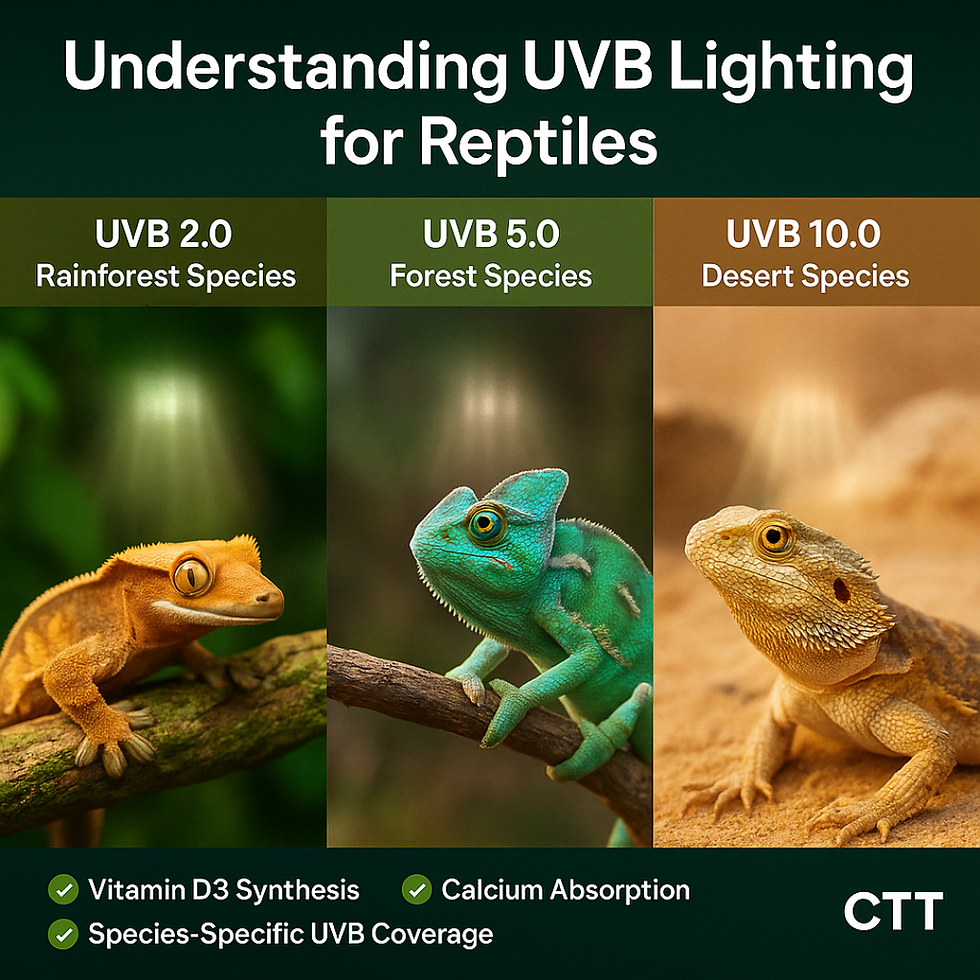
Here’s a quick breakdown:
UVB 2.0 – For deep forest species (shade-dwellers, amphibians)
UVB 5.0 – For tropical/subtropical reptiles needing moderate sun
UVB 10.0 – For desert reptiles that bask under full sunlight
With 8 LED models, CTT Light covers every habitat — all CE/RoHS certified and mercury-free.
Why Choose CTT Light UVB Solutions?
CTT Light develops UVB lighting systems engineered to deliver reliable UV output, even light distribution, and species-appropriate performance. Our products are designed to help reptile keepers create natural lighting environments that support healthy vitamin D3 synthesis, calcium metabolism, and long-term reptile well-being. Whether you're setting up a tropical gecko enclosure or a desert reptile habitat, selecting the right UVB system ensures safer and more effective lighting.
Choose the Right UVB Lighting for a Healthier Reptile
Using the correct UVB reptile light can dramatically improve reptile health, activity, and lifespan. Understanding the differences between UVB bulb types helps you create a safer and more effective habitat.
Explore our professional reptile UVB lighting solutions to find the best option for your setup.